
Long COVID (LC) and myalgic encephalomyelitis/chronic fatigue syndrome (ME/CFS) are chronic, complex, energy-limiting illnesses. They affect multiple body systems and are characterised by a range of symptoms, including — but not limited to — neurocognitive impairment (often referred to as brain fog), post-exertional malaise, chronic fatigue, sleep disturbances, pain, and physical disability.
A recent research paper (March 2025), funded by ME Research UK, used MRI technology to explore the role of neurochemicals in the brain in patients with Long COVID and ME/CFS.
The intention here is to explain the research, discuss the findings, and explore what this might mean therapeutically if you are impacted by — or suspect you may be impacted by — one of these conditions.
What did they do?
The study compared 17 patients with Long COVID and 17 patients with ME/CFS to healthy controls.
Magnetic resonance spectroscopy (MRS) — a specialised type of MRI scanning — was used to measure levels of brain neurochemicals in a specific region of the brain known as the posterior cingulate cortex.
The posterior cingulate cortex is involved in cognitive processes and has a relatively higher (around 40%) metabolic rate than other brain regions, meaning it has a high energy demand.
The neurochemicals assessed were:
- Glutamate (Glu)
- N-acetyl-aspartate (NAA)
- Glutamine
- Creatine
- Phosphocreatine
- Phosphorylcholine
- Glycerophosphorylcholine (GPC)
- Inositol (Ins)
Symptom severity was assessed using the NCNED Research Registry Questionnaire. Quality of life and functional capacity were also evaluated, including measures of pain, physical function, duration of illness, fatigue, and unrefreshing sleep.
What did they find?
The study found that glutamate levels were significantly higher in patients with Long COVID and ME/CFS compared to healthy controls. There was no significant difference between the Long COVID and ME/CFS groups.
In Long COVID specifically, N-acetyl-aspartate (NAA) levels were also significantly higher.
Both glutamate and NAA play important roles in memory, cognition (including attention, learning, and decision-making), and mood regulation.
Importantly, levels of these neurochemicals were associated with self-reported symptom severity, including:
- Physical function
- Cognitive impairment
- Unrefreshing sleep
- Pain
- Duration of illness
No other neurochemicals showed significant differences between groups. However, there were some additional correlations between neurochemicals and symptom severity within the ME/CFS group.
Although Long COVID and ME/CFS are often considered distinct conditions, research suggests that between 13–58% of Long COVID patients meet criteria for ME/CFS and experience similar symptoms.
Overall, the study suggests there may be overlapping pathology between these conditions, and that imbalances in neurochemicals may contribute to the complex symptoms experienced.
Elevated Glutamate
Glutamate is an excitatory neurotransmitter in the central nervous system, supporting neuroplasticity, cognition, learning, and mood.
As with many things in physiology, balance is key. When glutamate is either insufficient or present in excess, it may contribute to excitotoxicity.
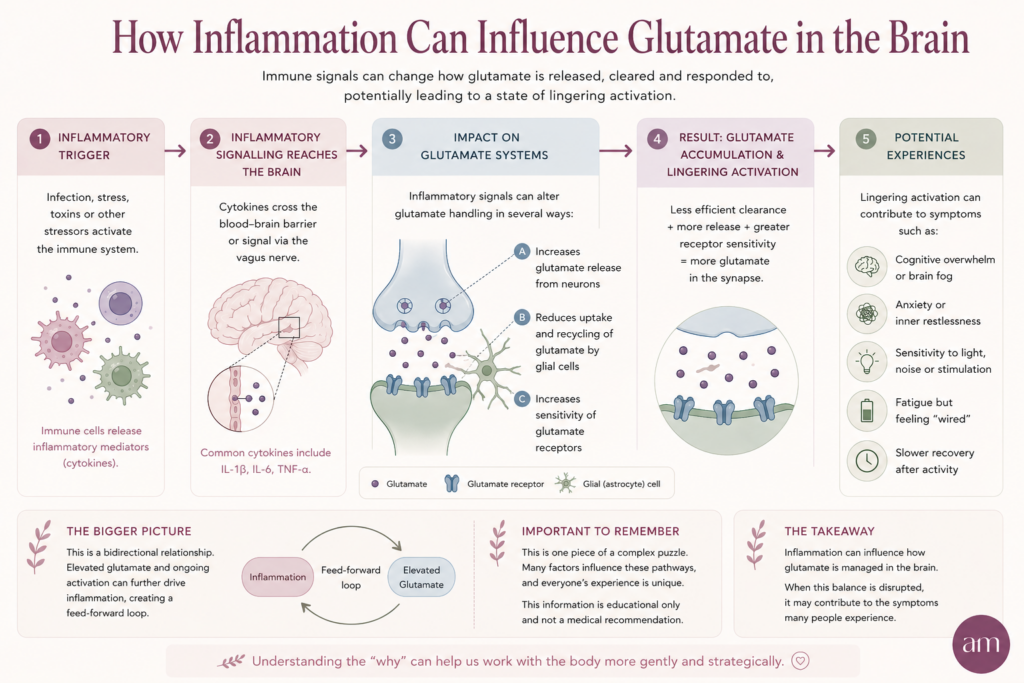
It is hypothesised that the elevated levels seen in Long COVID and ME/CFS may be linked to pro-inflammatory cytokines and activation of glial cells — in other words, inflammation and neuroinflammation.
Previous research suggests that inflammatory cytokines may:
- Influence glutamate release, transmission, and metabolism
- Reduce the number of glutamate receptors on astrocytes
- Decrease the activity of glutamate synthetase, which helps break down glutamate
In simple terms, inflammation in the brain and body may lead to an accumulation of glutamate. This can create a feed-forward cycle, where increased glutamate further stimulates inflammatory signalling.
This type of feedback loop may contribute to the underlying neurobiology of Long COVID and ME/CFS.
A simple way to understand this:
In a balanced system:
Signal → Response → Clear → Reset
In a dysregulated system:
Signal → Signal → Signal → delayed clearing → lingering activation
This sense of lingering activation may show up as:
- feeling tired, but still slightly wired
- difficulty switching off after activity
- a sense that your brain is still “on”
- low-level restlessness
- increased sensitivity to noise, light, or conversation
- thoughts feeling more busy or “sticky”
- a subtle underlying sense of unease
- taking longer to feel like yourself again after doing things
Elevated NAA
The study also found higher levels of NAA in Long COVID patients.
This may reflect a compensatory response to changes in brain metabolism — potentially indicating the brain is working differently, or under increased demand, rather than functioning less.
Neurochemicals and Symptom Severity
Physical Activity
Higher glutamate levels were associated with lower physical activity levels. Similar patterns have been observed in conditions such as fibromyalgia.
In ME/CFS, lower levels of glutamine, creatine, and phosphocreatine were associated with reduced physical activity.
Cognitive Impairment
Lower creatine and phosphocreatine levels were associated with cognitive impairment in ME/CFS, suggesting a potential link with energy availability in the brain.
Unrefreshing Sleep
Lower creatine levels were associated with more severe unrefreshing sleep.
Pain
Higher inositol levels were associated with increased pain severity, which has also been observed in fibromyalgia.
Illness Duration
Longer illness duration was associated with lower glutamine and creatine levels, both of which play roles in metabolic processes.
Long COVID and ME/CFS: overlapping pathology
One of the more important findings from this study was that there were no significant differences in brain neurochemicals between the Long COVID and ME/CFS groups.
At first glance, this may not seem particularly striking. However, when considered alongside what we see clinically, it becomes more meaningful.
Although these conditions may begin differently — for example, a viral trigger in Long COVID — they may share common underlying physiological processes.
This aligns with the overlap in symptoms often reported, including fatigue, cognitive dysfunction, post-exertional malaise, and reduced functional capacity.
Rather than viewing these as entirely separate conditions, it may be more helpful to understand them as different entry points into a shared network of dysregulation.
This network can involve:
- immune signalling
- nervous system regulation
- energy metabolism
- brain chemistry
From this perspective, it becomes less about identifying a single cause, and more about understanding how multiple systems interact and influence one another over time.
Study Limitations
No study is without limitations.
This was a preliminary study with a relatively small sample size, and it focused on a single brain region.
Additionally, MRS cannot distinguish between extracellular and intracellular glutamate, meaning the findings reflect overall levels rather than specific compartment changes.
Where does this fit into the bigger picture?
Despite its limitations, this study helps to highlight potential biochemical mechanisms that may contribute to symptoms.
What it also reinforces is the interplay between multiple systems, including:
- brain signalling
- immune activity
- energy production
- nervous system regulation
This helps explain why symptoms can be multifaceted, and why approaches focusing on a single pathway may feel incomplete.
Possible Support for Glutamate
Medication for Glutamate
In the context of glutamate signalling, some individuals have explored medications such as memantine.
Memantine works by modulating NMDA receptor activity, which plays a role in glutamate signalling. In certain contexts, this may help reduce excessive or prolonged activation.
There is emerging interest in its relevance in ME/CFS and Long COVID, although research is still limited and responses vary.
Any use of medication should be discussed with a qualified prescribing practitioner.
Low Glutamate Diet

You may come across the concept of a low glutamate diet, particularly in the context of neurological sensitivity.
For some individuals, this can be helpful — particularly where there appears to be increased sensitivity to more stimulating inputs.
In practice, temporary reduction of foods higher in free glutamate may support symptom management in certain cases.
However, this is not a universal approach. Glutamate is naturally present in many nutrient-dense foods, and unnecessary restriction may increase stress on the system or reduce dietary diversity.
Ideally, this is explored with appropriate guidance.
Supplements To Influence Glutamate
Some supplements may influence glutamate signalling by supporting conversion into more calming neurotransmitters or by supporting related systems such as energy production and inflammation.
Examples sometimes considered include magnesium, vitamin B6, glycine, taurine, and NAC.
However, responses can vary, particularly in more sensitive individuals, and supplements are best used as part of a broader, individualised approach.
Targeted support for Glutamate vs the bigger picture
While targeted interventions can be helpful, the study highlights inflammation as one possible contributor to altered glutamate signalling.
Inflammation rarely exists in isolation. It is often influenced by a combination of factors, which may include:
- digestive health and gut function
- diet and blood sugar regulation
- nutrient status
- nervous system regulation and stress
- environmental exposures
- pacing and energy management
Understanding inflammation in this way allows for a more integrated approach.
Rather than targeting a single pathway, it becomes possible to gently support the factors contributing upstream — which may, over time, influence downstream processes such as brain chemistry.
Final Thoughts
This is a valuable piece of research and adds to a growing body of evidence suggesting that there are measurable physiological changes underlying symptoms in both Long COVID and ME/CFS.
At the same time, it is still early. The study is small, focused on one brain region, and offers direction rather than definitive answers.
Perhaps most importantly, it highlights the complexity of these conditions — and the need to understand them as interconnected systems, rather than isolated issues.
If you’re trying to make sense of your own symptoms…
It’s very common to feel overwhelmed when reading research like this, particularly when it raises more questions than it answers.
If you’re trying to understand what may be relevant for your own case, and how to approach this in a more structured and individualised way, there are different levels of support available depending on what you need.
You can explore those options here if that feels like the right next step.