If you’ve been living with a chronic illness such as Long COVID or ME/CFS, you may have come across the idea of viral reactivation. The relationship between EBV reactivation and Long COVID has become an interesting area of research, particularly as scientists explore why some people continue to experience symptoms long after their initial infection.
Perhaps you’ve heard about Epstein–Barr virus (EBV), the virus responsible for glandular fever, or you’ve had blood tests showing antibodies to infections you experienced many years ago.
You may have wondered whether these viruses could be contributing to your ongoing symptoms. It’s a reasonable question, and one that researchers have been investigating for some time.
In August 2026, a large study published in Nature provided some interesting new insights into what happens to the viruses already living in our bodies when we become unwell with COVID-19.
The findings add to a growing body of research exploring the relationship between viral infections, immune dysregulation and longer-term health problems.
Before we explore the research, let’s start by understanding what viral reactivation actually means.
The viruses we carry with us
When we think about a viral infection, we usually imagine catching something, becoming unwell and eventually recovering as our immune system clears the infection.
However, not all viruses disappear from the body once the initial illness has passed.
Some viruses have developed clever ways of remaining in our bodies for many years, sometimes for the rest of our lives.
One example is Epstein–Barr virus (EBV), which belongs to the herpesvirus family. EBV is incredibly common, with approximately 90–95% of adults worldwide having been infected at some point in their lives.
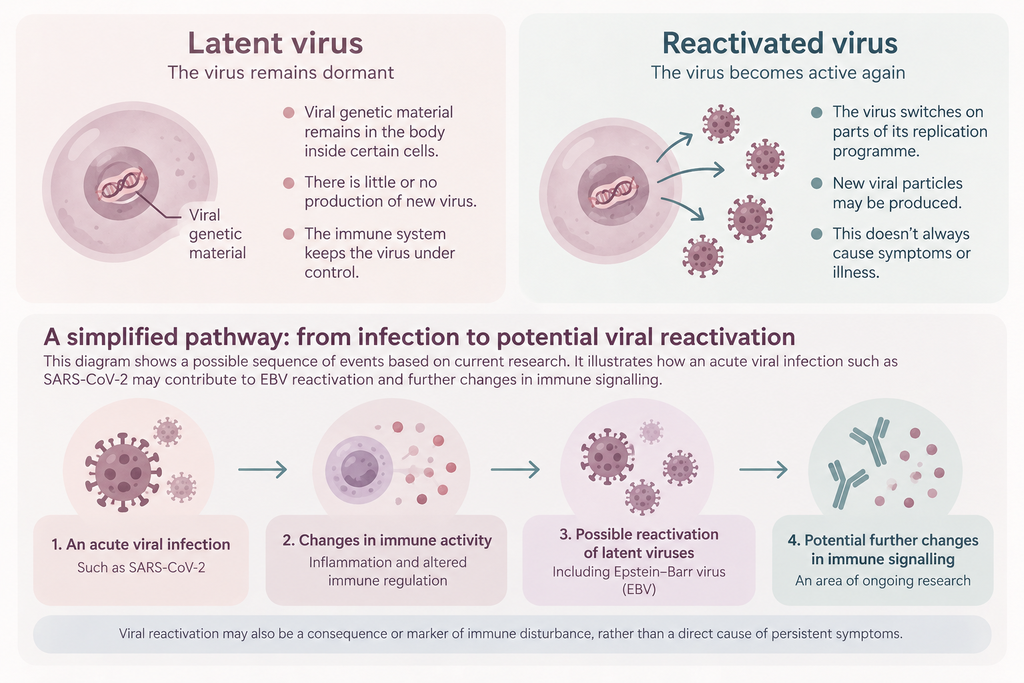
Following the initial infection, EBV can remain in certain immune cells, particularly B cells, in what we call a latent state.
This means the virus is still present, but isn’t actively producing large numbers of new viral particles.
Our immune system plays an important role in keeping the virus under control. In most healthy individuals, this relationship is maintained without any obvious problems.
However, under certain circumstances, a latent virus can become active again. This is known as viral reactivation.
Reactivation can occur during periods of physiological stress, including other infections and serious illness. Importantly, reactivation doesn’t always cause symptoms or result in disease.
In fact, low-level viral activity can sometimes occur without us even knowing about it.
This distinction is important because finding evidence of viral activity doesn’t necessarily mean that the virus is responsible for someone’s symptoms.
What did the new Nature study discover?
In August 2026, researchers published a study titled Virus reactivation in acute and long COVID-19.
The study followed 1,154 patients who had been hospitalised with COVID-19 across 20 hospitals in the United States. Researchers collected samples during the acute illness and followed participants for up to 12 months.
Rather than looking exclusively at EBV, the researchers investigated several different viruses that can remain in the body.
These included:
- Epstein–Barr virus (EBV)
- Cytomegalovirus (CMV)
- Herpes simplex virus type 1 (HSV-1)
- Anelloviruses, a group of viruses commonly found in humans that are not generally known to cause disease
The researchers used sophisticated laboratory techniques to look for viral genetic activity in blood and respiratory samples. This is particularly important because many earlier studies relied heavily on antibody testing, which can be difficult to interpret when investigating viral reactivation.
They found evidence of activity from at least one additional virus in approximately 48% of the patients assessed during acute COVID-19.
Different viruses also appeared to become active at different stages of the illness:
- EBV was commonly detected early
- CMV and HSV-1 tended to become more prominent later in the disease course
The researchers also found that viral activity was associated with more severe COVID-19 illness and changes in immune function.
However, there is an important distinction to make here.
The researchers identified an association between viral reactivation and disease severity. They did not establish that viral reactivation was causing more severe illness.
It’s possible that viral reactivation contributes to inflammation and illness severity. It’s also possible that the immune disturbances associated with severe illness create an environment in which previously controlled viruses become more active.
Both processes could potentially occur together.
This is one of the questions that future research will need to answer.
Viral reactivation doesn’t necessarily mean a weak immune system
One particularly interesting finding was that viral reactivation wasn’t restricted to people taking immunosuppressive medication. We often think of viral reactivation as something that happens when the immune system becomes weakened or suppressed.
However, our immune system is much more complicated than simply being strong or weak.
It consists of many different cells, chemical messengers and regulatory processes that need to work together.
During an acute infection, some parts of the immune system may become highly activated, producing inflammatory signals designed to help us respond to the infection. At the same time, other aspects of immune function may become altered or less effective.
For example, the immune cells responsible for keeping certain viruses under control may not function in their usual way. This means that increased inflammation and impaired antiviral control can potentially exist alongside one another.
In the Nature study, the researchers found that different patterns of viral activity were associated with changes in inflammatory signalling molecules, immune cell populations and gene expression.
Some of these changes remained associated with viral activity even after the researchers accounted for differences in COVID-19 severity. This suggests a complex relationship between the viruses we carry and the way our immune system responds during illness.
Rather than thinking about the immune system as something we simply need to boost, it may be more helpful to understand the importance of immune regulation.
A well-functioning immune system needs to respond appropriately to a threat, but it also needs to regulate that response and return towards balance when the immediate danger has passed.
Could viral reactivation contribute to Long COVID?
This is where the research becomes particularly relevant to people living with persistent symptoms following an infection. Long COVID is a complex condition, and research increasingly suggests that there may be several different biological processes contributing to symptoms.
These include:
- Immune dysregulation
- Ongoing inflammation
- Changes in blood vessel function
- Autonomic nervous system dysfunction
- And, in some individuals, possible viral persistence or reactivation.
The Nature researchers investigated whether viral activity was associated with symptoms during the recovery period. Interestingly, they did not find a significant relationship between viral reactivation during the acute illness and the different groups of longer-term symptoms they assessed.
However, they did identify an association between the detection of Anelloviridae during recovery and a group of patients experiencing persistent physical limitations.
Anelloviruses are particularly interesting because they are widespread in humans and generally aren’t considered disease-causing viruses. Their activity may instead provide information about the state of the immune system.
It’s possible that detecting these viruses could eventually help researchers identify certain patterns of immune dysfunction associated with prolonged illness.However, we’re not at the point where these findings can be used to diagnose Long COVID or guide routine treatment.
We also need to remember that this study involved people who had been hospitalised with COVID-19 during the early stages of the pandemic. We cannot assume that the same findings would apply to everyone experiencing Long COVID, particularly those who had relatively mild initial infections.
EBV Reactivation and Long COVID: What About Autoimmunity?
A second paper, published in the Journal of Microbiology, Immunology and Infection in March 2025, explored the relationship between COVID-19, EBV reactivation and autoimmune disease.
Unlike the Nature study, this was a review of existing research rather than a new clinical investigation.
The authors examined evidence suggesting that COVID-19 may increase the risk of developing or exacerbating certain autoimmune conditions, and considered whether EBV reactivation could be one of the contributing mechanisms.
To understand why this might matter, we need to return to the B cells, previously mentioned. B cells are an important part of our immune system. Among other functions, they can develop into plasma cells that produce antibodies to help protect us against infections.
However, antibodies don’t always behave as intended. In autoimmune conditions, the immune system mistakenly targets parts of the body’s own tissues.
EBV has a particular relationship with B cells because these are among the cells in which the virus can remain latent. Researchers have proposed that EBV infection and reactivation may influence B-cell regulation and, in susceptible individuals, contribute to processes involved in autoimmunity.
The relationship between EBV and multiple sclerosis is particularly well established, although EBV infection alone is not sufficient to cause the disease.
The 2025 review explores the possibility that inflammation and immune disturbances during COVID-19 could encourage EBV reactivation, which might then contribute to further immune activation.
This creates the possibility of a feedback loop, where an acute infection alters immune function, latent viruses become more active and their activity potentially influences the ongoing immune response.
It’s an interesting hypothesis, but there are still significant gaps in our understanding.
The researchers acknowledge that we don’t yet know whether EBV reactivation is directly responsible for the development or worsening of autoimmune conditions following COVID-19. Other immune changes caused by the initial infection may also contribute.
What does this mean for people living with ME/CFS or other post-viral conditions?
Although these two publications focus specifically on COVID-19, they raise interesting questions about post-viral illness more broadly.
We know that ME/CFS can develop following a variety of infections, and researchers have been investigating possible relationships between persistent viruses, immune function and symptoms for many years.
There are also important similarities between some presentations of Long COVID and ME/CFS, particularly when people experience profound fatigue, cognitive difficulties, orthostatic intolerance and post-exertional malaise.
However, similarities between conditions don’t necessarily mean that they share exactly the same underlying mechanisms. However, more research is needed.
The findings from these studies cannot be directly applied to everyone living with ME/CFS, and they don’t establish that viral reactivation is the cause of the condition. What they do provide is further evidence that the relationship between infections and the immune system can be complex and may continue to evolve after the initial infection.
This is an important area for ongoing research.
Should you be testing for viral reactivation?
When we read research identifying a potential biological mechanism behind chronic illness, it’s understandable to want to investigate whether that mechanism might be affecting us personally.
However, there’s an important difference between a finding that is interesting from a research perspective and a test that provides useful information in clinical practice.
EBV antibody testing is a good example. Because EBV infection is so common, many adults will have positive EBV IgG antibodies.
These antibodies can remain detectable for life and generally indicate previous exposure to the virus. A positive EBV IgG result does not, by itself, mean that the virus is currently active or causing symptoms. Even when antibody patterns suggest possible recent viral activity, interpretation can be complicated.
Different laboratory markers provide different information, and some findings can persist or fluctuate without necessarily indicating clinically significant reactivation.
The Nature researchers used specialised techniques to detect viral transcripts, alongside extensive analysis of immune cells, inflammatory proteins and metabolic changes. These research methods aren’t equivalent to ordering a standard EBV antibody panel.
At present, we don’t have sufficient evidence to recommend routine testing for viral reactivation in everyone living with Long COVID or ME/CFS.
There may be situations where investigating a particular infection is clinically appropriate, but this should be guided by someone’s symptoms, medical history and assessment by an appropriately qualified healthcare professional.
It’s also worth remembering that identifying a possible abnormality doesn’t automatically mean that we have an effective treatment for it.
There is currently insufficient evidence to recommend antiviral treatment solely on the basis of suspected EBV reactivation in people with Long COVID or ME/CFS.
Research is ongoing, and I hope that our understanding of these mechanisms will eventually lead to more targeted and effective treatments.
For now, I would encourage caution around extensive testing or treatment protocols based on findings that are still being investigated.
Understanding the bigger picture
In my clinical work, I often meet people who have spent years trying to understand why they remain unwell. They may have investigated infections, nutritional deficiencies, gut health, inflammation, hormonal changes and many other possible contributing factors.
Sometimes these investigations provide useful information and help guide appropriate treatment. At other times, they can create more questions than answers.
I think one of the challenges of living with a complex chronic illness is knowing when further investigation is helpful and when it may be adding to an already overwhelming situation.
Research like this is valuable because it helps us build a better understanding of what may be happening beneath the surface. But we don’t necessarily need to investigate or intervene in every biological process that researchers identify.
There is still value in addressing the aspects of health that we understand more clearly, while remaining open to new scientific discoveries.
For someone living with an energy-limiting condition, this might include developing an appropriate approach to pacing, supporting adequate nutrition, addressing sleep difficulties, identifying and managing orthostatic intolerance, and receiving appropriate medical assessment and treatment.
This is also why I created Nurturing Resilience, my online membership for people living with energy-limiting conditions. I wanted to provide an affordable space where people could learn about these foundations, access practical support and gradually build stability and resilience, without feeling that they need to investigate or fix everything at once.
These approaches won’t resolve every underlying mechanism of illness, and they aren’t substitutes for further investigation when it’s clinically indicated.
However, they can provide a practical starting point while research continues to develop.
Final thoughts
What I find encouraging about these publications is that they help us understand the complexity of the relationship between viruses and our immune system.
The Nature study demonstrates that viral reactivation can occur during severe illness and is associated with changes in immune activity, inflammation and clinical outcomes.
The 2025 review provides a possible biological explanation for how viral reactivation, particularly EBV, might interact with immune regulation and autoimmune processes.
There are still many unanswered questions.
We don’t yet know whether viral reactivation is a cause, a consequence or a combination of both in different individuals. We also don’t know whether targeting viral reactivation will improve outcomes for people living with Long COVID or other post-viral conditions.
But each carefully conducted study adds another piece to our understanding.
If you’re living with a chronic illness, I hope this research offers some insight into why recovery can be complicated, without leaving you feeling that there is another long list of things you need to investigate.
Understanding more about our biology can be helpful, but it doesn’t mean we have to work everything out before we can begin supporting our health.
And sometimes, while science continues to explore the bigger questions, there is still meaningful work we can do with what we already know.
Research references
**1. Maguire C, et al. (2026).** Virus reactivation in acute and long COVID-19. Nature, 656. Published online 5 August 2026.
https://doi.org/10.1038/s41586-026-10740-z
**2. Tarasco MC, Iacomino N, Mantegazza R, Cavalcante P. (2025).** COVID-19, Epstein-Barr virus reactivation and autoimmunity: Casual or causal liaisons? *Journal of Microbiology, Immunology and Infection*, 58, 508–516.
https://doi.org/10.1016/j.jmii.2025.03.014
This article is intended for educational purposes and does not replace individual medical advice, diagnosis or treatment.