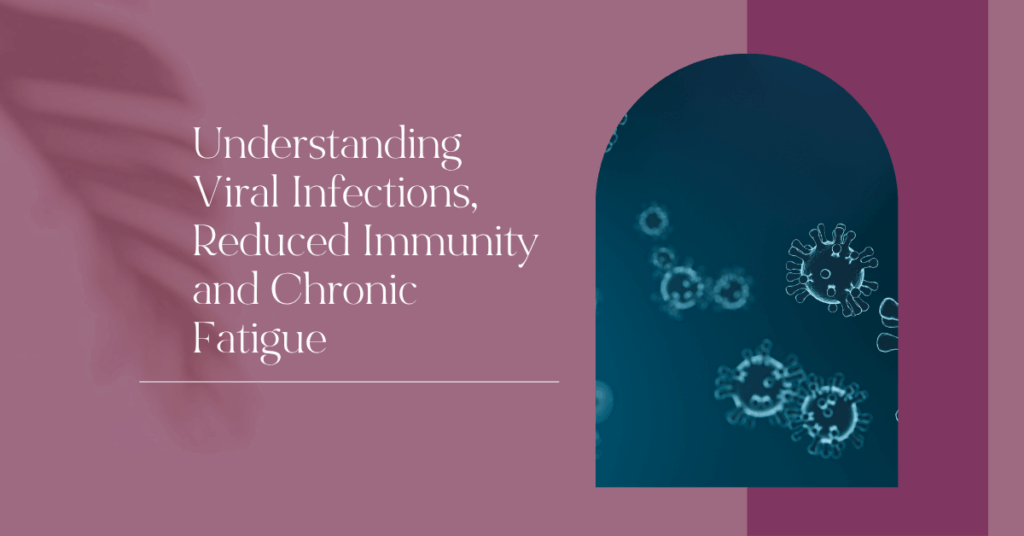
Many people with chronic fatigue are susceptible to chronic viral infections, viral persistence and/or viral reactivation.
Although antiviral medications and herbs can offer benefit and relief, the bigger picture for long term health is supporting the immune system.
In this blog we will explore:
- Recurrent viral infections
- Recurring latent infections
- Viral Persistence
- Viral Activation of autoimmunity
- Useful Testing
- How to support the immune system, especially considerations for those who have more immune compromised
Recurrent Viral Infections
Recurrent viral infections include repeated infections such as:
- The flu
- SARS-CoV-2
- Rhinovirus (common cold, sinusitis, bronchitis)
- Adenovirus (conjunctivitis, upper respiratory, bronchitis)
- Norovirus (stomach flu)
- Rotavirus (diarrhoea)
- Parainfluenza virus (sinusitis)
- Respiratory syncytial infection (otitis media, common cold)
- Parvovirus (gastroenteritis)
It is normal for someone to experience these infections from time to time, feel unwell and then get better. However, when these infections are recurring and prevent someone from moving forward with their health, we must consider the state of the immune system, specifically, why the person is immune compromised.
Often I work with clients who are falling ill every 4 to 6 weeks and this prevents them from getting good traction on their recovery. We will discuss more about what to do in this scenario but I have seen a lot of success working through some basic principles such as digestive health, eating enough protein and mastering pacing and good sleep.
Recurring Latent Infections
Recurring Latent Infections are infections that a healthy immune system can keep in check. However, in moments of immune weakness and compromise, the host’s immune system may no longer be able to keep the infection in its latent state and it may reactivate.
A well known example of this Herpes Zoster. This is the virus responsible for varicella also known as chickenpox. Many children may have chicken pox as a child, but when this reactivates later in life, it is known as shingles.
Clinically, latent viruses reactivate when someone is severely immunocompromised. It can be helpful to use antiviral medications but the longer term goal will be to address the immune compromise and support the immune system as whole.
Viral Persistence
Viral persistence refers to the ability of a virus to evade the immune system and remain in a host organism for extended periods of time, often without being completely cleared by the immune system.
This means the virus can continue to exist in the body—sometimes for months, years, or even for life—after the initial infection. The long-term health effects of viral persistence include chronic inflammation, immune system dysfunction, or even cancer (e.g., HPV leading to cervical cancer).
SARS – CoV2 and Viral Persistence
SARS – CoV2 may persist in the body via prolonged viral RNA shedding, tissue persistence and in rare cases persistent infections. Prolonged viral RNA shedding is continued detection of genetic material from sinus, throat and stool samples weeks and months after the initial infection. However, this does not mean that the infection is active. In some cases, especially in those with immune compromise, the virus may still be active and replicating. Tissue persistence refers to findings of the virus RNA and protein in tissues such as the brain, lungs, gut and heart, months after the initial infection.
The consequence, which is important in the case of long covid, is that viral remnants may keep the activated, leading to chronic systems such as fatigue, brain fog and joint pain, to name but a few. Persistence in the gut may contribute to gastrointestinal imbalances, as well as systemic imbalances and inflammation.
That being said, not all cases of Long Covid may be associated with viral persistence and if viral material is detected, this does not always mean that it is active.
Viral Activation of Autoimmunity
If you have experienced a persistent decline in health since experiencing a virus, it is worth considering and ruling out viral activation of autoimmunity. This is when a virus is a trigger for the onset of an autoimmune condition in a genetically susceptible individual. For example, epstein barr virus can be a trigger for Hashimoto’s Thyroiditis.
The most accessible marker for autoimmunity is anti-nuclear antibodies (ANA), which may be offered by your regular doctor. However, although ANA may help facilitate the diagnosis of some autoimmune conditions, it may not be able to identify and rule out all types of autoimmunity.
A more favourable test would be the Cyrex Array 5, which is a Multiple Autoimmune Reactivity Screen. It tests for 24 different protein targets and therefore offers a more comprehensive picture of autoimmune potential. The test does retail at $671 and would need to be arranged through a qualified provider e.g. Nutritional Therapist or Functional Medicine Doctor in the UK.
Although not everyone has the resources for this type of testing, if your health is impacting your quality of life long term, getting to the bottom of your clinical picture is essential.
Testing For Acute Infections and Viral Reactivation
Testing For Acute Infection
An acute infection can, but not always, be highlighted in a Full Blood Count (FBC). This is a standard panel that your regular doctor will be able to run for you. You can also use a private testing company such as Medichecks.
Markers that may be elevated in acute infection are:
- Increased white blood cell count
- Increased lymphocytes
If an infection has become chronic we may see:
- A low white blood cell count
- Increased neutrophils
- Suppressed lymphocytes
Infections may not always show up on a complete blood count so other testing options include:
- Complement proteins
- T cells
- B cells
- Natural Killer Cells
The best test for this is the Lymphocyte Map by Cyrex Laboratories (currently only available in the US). The next best options are with Armin Labs based in Germany.
Due to the hassle with testing, I seldom run these tests but tend to rely on the complete blood count, taking a detailed client health history and current symptoms.
IgG and IgM Antibodies
If you are experiencing a post-viral syndrome, the infection may have been and gone. However, provided you test for the appropriate infection, you may find IgG antibodies. IgG bodies will tell you that you had the infection (at some point in time), but they do not indicate a current infection.
It is noteworthy that:
- 53% of the population will have antibodies to herpes simplex virus
- 98% of the population have herpes zoster (chickenpox)
- 90% of the population will test positive for epstein barr virus (EBV)
However a positive result for IgM can suggest a reactivation of this latent virus.
Immunosciences offers a Comprehensive Viral Panel that will test for both IgG and IgM for:
- Cytomegalovirus (CMV)
- Epstein Barr Virus (EBV)
- Herpes Simplex Virus (HSV)
- Human Herpes Type 6
- Rubeola (Measles)
- Varicella zoster IgG (Chickenpox / Shingles)
Monocytes
Monocytes make up part of the Full Blood Count. An elevation in monocytes (>7%) can indicate the reactivation of herpes virus, including:
- Cytomegalovirus (CMV)
- Epstein Barr Virus (EBV)
- Herpes Simplex Virus 1 and 2 (oral and genial herpes)
- Varicella zoster (Chickenpox / Shingles)
There can be other reasons for elevated monocytes, therefore, this should also be associated with fever, fatigue, sore throat and muscle aches.
Support For Overcoming Viral Challenges
Antiviral therapies are commonly recommended as part of a fatigue recovery support plan, however, we must consider the following:
- In the case of post-viral fatigue, the infection may be long gone and therefore we may rather need to consider how we support the organ system impacted and /or infection induced autoimmunity. Antiviral therapy may not be helpful in this case.
- In the case of recurrent infections or the reactivation of latent infections, the host is most likely immune compromised and therefore we need a well rounded approach to support the immune system of the host, perhaps with some antiviral support.
- In cases of viral persistence, action can be taken to displace the virus from the receptor site e.g. nicotine patches or possibly some nightshade vegetables.
Support For The Immune Compromised
When someone is immune compromised how we support them starts with how we support anyone who is experiencing chronic fatigue or a chronic illness. It starts with basic foundations:
- Sleep
- Stable Blood Sugar
- Macro-nutrition; High quality diet with adequate protein intake (1g per pound of ideal body weight) and intake of essential fatty acids (omega 3 fatty acids)
- Micro-nutrition; vitamins ADEK, Iron, Copper, Zinc, Vitamin B and Vitamin C
- Optimal digestive health which we can encourage with things like probiotic, saccharomyces boulardii, short chain fatty acids and mucosal membrane support
- Optimal movement routine within capacity (see here & here for guidance)
- Pacing
- Nervous System Support
This may sound pretty basic and obvious but you would be surprised how many clients I see on complex supplement protocols who have not addressed these basic concepts. Just eating better, sleeping better, moving a little and supporting the nervous system can go a long way to improving immune function). I have seen many clients improve just from eating more protein.
Additionally on a case by case basis we may want to consider:
- Adrenal Function
- Sex Hormones
- Chemical and toxin exposures (e.g. mould mycotoxins)
- Other ongoing infections e.g. bacteria, parasites, yeast and mould
- Overtraining
- Smoking
- Drugs and alcohol use
- Eating disorders
Specific Support for Viral Infections
Once the basics are in place we can use the following to support the immune system further:
| Natural Killer Cells & T Cell Support | B Cells | Biofilm Disruptors |
| Astragalus Echinacea Lemon Balm Beta Glucans | Grape Seed Extract Adequate Protein Green Tea Pine Bark Extract Resveratrol | Oregano Curcumin Quercetin NAC Garlic Monolaurin Berberine Nattokinase |
Supporting Autoimmunity
If your symptoms are due to infection induced autoimmunity, the case becomes a lot more complex. It goes beyond the scope of this blog to go into more detail but generally speaking, following many of the principles already discussed will set some great foundations.
Viral Persistence, Nicotine Patches and Nightshades
One strategy that has become popular in the Long Covid Community is the use of nicotine patches to displace persistent viral material from receptor sites and in doing so, modulate the immune system and reduce inflammation potentially triggered by viral remnants.
Nicotine interacts with the cholinergic anti-inflammatory pathway through the α7 nicotinic acetylcholine receptor (α7nAChR), which can dampen excessive immune responses and cytokine release.
Since Long COVID symptoms are thought to be partly driven by chronic low-grade inflammation or immune dysregulation—possibly due to viral persistence—nicotine’s immunomodulatory effects might help restore balance and alleviate symptoms.
Additionally, there is some research to suggest that vegetables if the nightshade family contain Anatabine and Anabasine which are structurally similar to nicotine, may interact with the α7 nAChR, though usually with lower potency.
Due to potential side effects, this should ideally be done when you have enough stability in your system from applying some of the foundational habits.
Big Take Aways
If you are someone who has had a virus and has never felt the same since, if you experience viral reactivation or recurring infections you want to support the body as a whole, especially your immune system. Many clients come to me on complex aggressive protocols but they haven’t mastered the basic foundations that help to build up the body’s resilience. Do not underestimate the power of applying the basics (with consistency!).